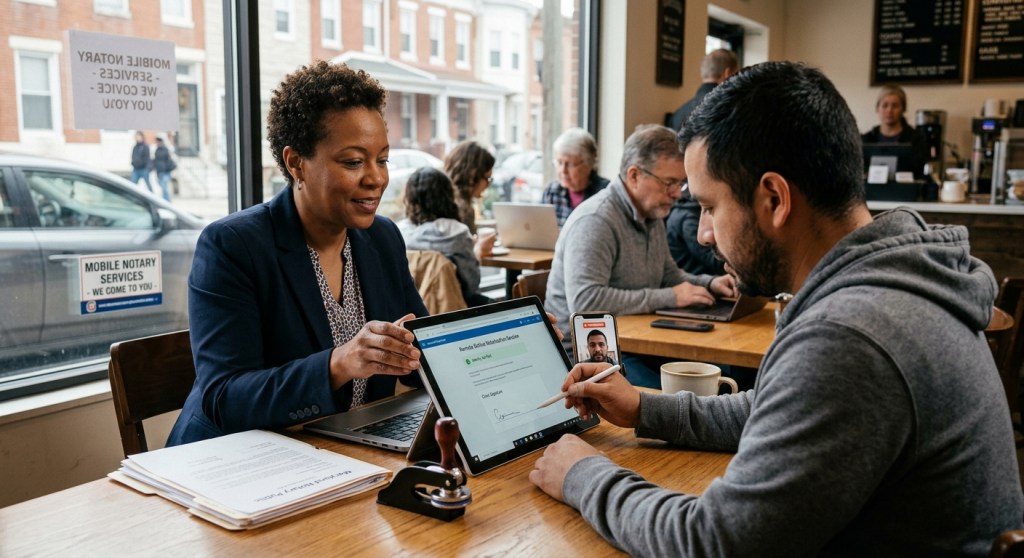
When people refer to “mobile notarization as an online service,” they are typically talking about Remote Online Notarization (RON) accessed via a smartphone or tablet. While a traditional “mobile notary” is a person who physically travels to your location, an online notary service allows you to legally notarize documents from anywhere using your device’s built-in camera and microphone.
How the Mobile Online Process Works
- Upload the Document: You can upload a PDF directly from your device or take a clear photo of a paper document.
- Verify Your Identity: The platform will prompt you to take a picture of your government-issued ID (like a driver’s license or passport). You will also answer a few knowledge-based authentication questions (e.g., verifying past addresses or vehicles).
- Connect via Video: You are connected to a secure, recorded video call with a live, state-commissioned notary public.
- Sign and Seal: The notary verifies your identity on camera, witnesses you apply your electronic signature, and attaches their digital notary seal.
- Download: You immediately receive a legally binding, digital PDF of your notarized document to save, email, or print.
Top Mobile-Friendly Platforms
- Notarize (by Proof): Widely considered the industry standard for consumers. They offer a dedicated mobile app, have notaries available on-demand 24/7/365, and typically charge $25 for a single document seal.
- OneNotary: A highly accessible platform that works smoothly through mobile web browsers without needing an app download, offering 24/7 service.
- DocuSign Notary: Best suited for businesses that need to send documents to clients. It integrates RON directly into the standard DocuSign e-signature workflow.
- Snapdocs: Primarily used for real estate and mortgage closings, coordinating both mobile traveling notaries and remote online sessions.
Requirements and Legality
Remote online notarization is legally valid and recognized across all 50 states. To complete a session on a mobile device, you need a strong internet or cellular connection, a working camera and microphone, a valid U.S. Social Security Number (required to pull the identity-verification questions), and an unexpired government-issued photo ID


Leave a comment